

This is an original editorial piece created by Mimaz. It is the first in a series of editorials that we like to call “The Half-Life Dissertation”, which will aim to extensively cover a wide range of Half-Life related topics and issues.
Valve are looking down the rabbit hole.
The Failure of the Half-Life Episodes
Discussion & Analysis
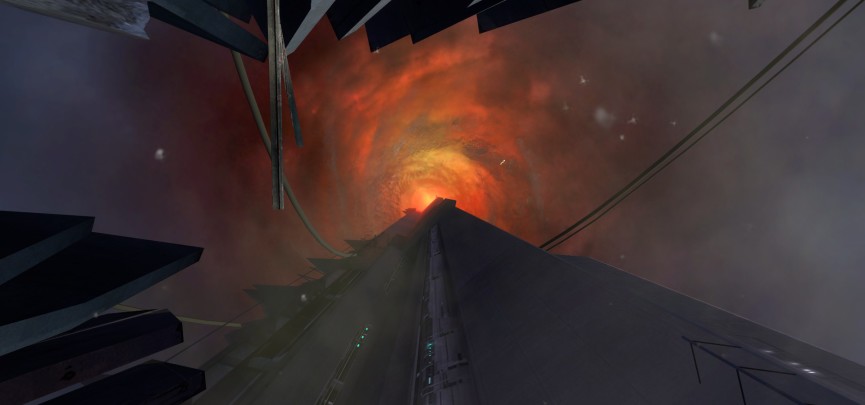
In the past few weeks, it has become increasingly clear just how chaotic the development of the next Half-Life has been since Episode Two was released almost five years ago. Gabe Newell has revealed that many ‘twists and turns’ have occurred in the interim and that Half-Life’s future has been hampered by a whole range of various complications.
Public expectations have likewise shifted gradually as year after year of persistent silence has dragged on. No one is expecting a mere episode that offers nothing more than a continuation and extension of Half-Life 2’s proven formula. We’re expecting something radically different in the form of what we now collectively assume will be Half-Life 3. We ought to. It’s been a long time, and given Valve’s history of building innovative products, there’s little doubt that they’ve become very ambitious since 2007.
It’s been interesting seeing this transition. No official announcement has ever been made with confirmation that Half-Life 3 has superseded Episode Three. The conception almost universally accepted by the fanbase, however, is that this is exactly what has happened. Valve themselves have in the last year started using the title in response to questions about the series as if in an attempt to bury the possibility of an Episode Three.
This isn’t a surprise. Valve’s decision in 2006 to pursue episodic content for Half-Life was, in retrospect, a dreadfully short-sighted mistake that has unfortunately pushed the series against the wall with little room to maneuver creatively and economically. I don’t mean to say that the Episodes are bad. They really aren’t, and I understand the reasons why Valve went down that road. They’d spent six tumultuous years trying to get Half-Life 2 done, enduring a lot of stress along the way, and they wanted to make things easier for themselves. I sympathize with that, but in their attempt to do so they lost something important.
The Episodes lost something important.
“Half-Life was MADE to be monolithic.” A good friend of mine said that to me a few days ago and it really put things in perspective. It was such an obvious thing to say, but I hadn’t really thought about it in such a direct way before.
I like the Episodes as self-contained experiences, but they are distinctly fallible in the grand scheme of the series and simply do not hold up to the same level of quality as their monolithic predecessor. They aren’t anywhere near as ambitious or as innovative or as masterfully crafted. They fall into a comfort zone that relies on a tired formula, only innovating in minor increments and thus, they do not live up to the potential expected of them. They are in many ways comparable to the original Half-Life expansion packs, which likewise took the original’s assets and weapons and themes while giving them a new coat of paint.
We don’t expect such a constrained attitude from Valve. Valve don’t expect such a constrained attitude from Valve. This realization would have undoubtedly fueled the decision to ultimately abandon the format.
Half-Life 2 is brilliant, and it was achieved precisely because the game went through such a troubled development cycle with numerous restarts and retreads over the course of six years. They kept going and going until they had it exactly the way they wanted. Exactly the way they needed. The development of the Episodes, by contrast, seemed too simple; too quick; too easy, and I think their quality shows. It’s a lesson in realizing that creating truly transcendental experiences for any art form (games included) is challenging, and requires a great deal of time and effort and passion. These can’t be shrugged off for the sake of sheer convenience.
The very existence of Episode Two and the way it ended, though emotionally significant, is a big part of the reason why the series has been put on hold for so long. Certain issues are immediately obvious. How does Valve start the next game when we expect to continue on from the point we left off after five years of absolute silence? How does Valve move on from such a cliffhanger, and build on all the set-up in a way that’s faithful to an intricate narrative spanning four games, without alienating a new audience? Do we expect people to read up on the series, or go back and play games that are over five years old? Although they arguably should, the reality is that most people simply aren’t interested in playing three different games just to find out what’s been going on. Perhaps Half-Life 2‘s detachment from its predecessor’s setting and its immediate aftermath, is what made it so simple and sublime to experience, even for someone who had never heard of Half-Life in their life.
What’s more, the next Half-Life will, to some extent, rely heavily on some of the conventions of the previous games – early on in the game, at the very least. We’re still playing in exactly the same fictional setting, and little will change dramatically in the time between Episode Two’s ending and the start of the next game. This limits Valve’s creative legroom and potential for originality. It was an incredible experience stepping into City 17 for the first time in Half-Life 2, and I don’t see how Valve can possibly encapsulate that same engrossing atmosphere of stepping into a new world and feeling awed by it when we will likely be waking up in an extremely familiar environment.
This is a huge contrast with Episode One’s ending. The Citadel’s going up in a ball of destructive exotic particles, you’re leaving behind the familiar confines of City 17 (as well as its immediate environs), and then you black out. It was a great opportunity to facilitate a fresh start. We were heading into a new environment – the Wasteland – that didn’t need to be bound by the same conventions and sensibilities we’d grown comfortable with. It could have served as a perfect transition between Half-Life 2‘s familiar setting, and a completely new world which would have sported its own style and tone.
Instead, Episode Two provides ‘more of the same’. It’s a wilderness representative of rural Seattle (rather than Eastern Europe). It’s mundane and uninteresting, and doesn’t convey any of the consequences or effects we’d expect after two decades of the Combine’s widespread and destructive dominion. It’s one of many examples in the Episodes where Valve merely allude to the state of the world without ever visually demonstrating it and that is a misstep which sadly cannot be rectified.
Episode One was, of course, originally titled Aftermath and I think it should have stayed that way. With a few changes and a slightly longer campaign it could have been a great piece of ‘bridging content’ between Half-Life 2 and Half-Life 3. In much the same way Episode One does right now, it could have set up the next phase of the conflict in the series – the G-Man’s loss of control over the player, the rise of the Vortigaunts as a major power, humanity’s liberation from Combine subservience – by getting Gordon Freeman and other key characters out of City 17 and into the unknown.
In this hypothetical situation, building Aftermath would have been necessary, I think, otherwise Valve would have had too much to juggle in a Half-Life 3. The events of Episode Two, then, could have constituted the first act of Half-Life 3. The second act could have seen the player travelling to the Borealis. The third act could have seen us going off-world to other dimensions, including the Combine Overworld. This could have allowed Valve to explore in more intimate detail many of the things Kleiner alludes to in Episode One that Episode Two ultimately fails to properly address (the Resistance’s triage centers, for one).
I think this is perhaps the best example of the potential wasted by Valve in their decision to create episodic content, and how they’ve made the transition to the next Half-Life so very difficult for all of us.
Here’s my opinion; One day, there’s going to be an update to EP2 which drastically changes the ending, and that ending is the one that HL3 is going to use. They did it for Portal, and the ARG that ensued was incredibly fun. Call me crazy, but that’s what I’m expecting.
I am afraid you are quite mistaken. For one, Portal’s ending was not a heavily emotional scene in which one of Half-Life’s oldest and finest characters is brutally slaughtered before our very eyes, nor was it a gigantic cliffhanger for an episode set to be released in little more than one year. So for Portal, adding to the ending worked very well… especially since what they did add to Portal’s ending was something they initially intended on having anyway, but ultimately cut out.
Besides, EP2’s ending does not need to be changed. Therefore, I’d say the problem remains, and the solution you propose is rather… dysfunctional.
I can’t even imagine what kind of game created if Valve started HL3’s development between 2006 – 2008 with that time all ideas flooding and gathering in a pool and good ideas selected, game evolved while it’s being developed.
I have a conspiracy that the Half-Life story line was written in an illogical way and that it conflicted with the Half-Life 3 plot. Instead of fixing it and announcing their mistake, they just ignored the issue and went to work on other games.
Great post, and I second Pikminiman’s sentiments in that I am equally impressed and depressed by it.
Your observations on the shortcomings of the structure of the series are spot on. It’s something I briefly touched upon in a piece I wrote about Episode One in February (http://figpig.blogspot.co.uk/2012/02/episode-ones-place-in-grand-scheme-of.html) but hadn’t extended this thought across to Episode Two. Perhaps this would not have been true if Ep2 had flowed directly into Ep3 as was planned, but as it is it really stands out in its inconclusiveness. It’s the only game in the entire series which doesn’t end with some sort of blackout or G-Man-induced stasis.
Just wanted to thank you for the well thought-out article. Very interesting. I look forward to your future installments. Just one suggestion, maybe include some cool screenshots or pictures every once in awhile to lighten up the article 🙂
Good idea. I think we’ll do just that whenever we can in this series, as well as in the future overall.
A late game is only late until it’s released; a bad game is bad forever.
— Shigeru Miyamoto
Words of Wisdom
Loved the article. Want more!
Great to see another familiar face part of LambdaGeneration. I’ve missed reading your posts on the forums. And our little chats. Nice article btw, I have to say I agree with most of it.
How is life in the Steamcast forums? I haven’t mustered enough interest to join, but I hope to at least have interesting discussions with you in the comment sections here.
Can’t say I’m surprised by the sort of behavior this article has already attracted. Terrible article/perfect article. Good god.
Hi supernaut. The Steamcast Forum is pretty quiet these days. Unlike SUF, there’s no ‘beating a dead horse’ with topics that have already been discussed to death. Glad to hear you liked the article. I’m not surprised by the reaction either. What more can one really expect from a gaming forum?
We do have our own forums, but they are pretty dormant at the moment. I suppose our comments feature more than enough insightful discussion and discourse, but I’d like to get the forums revived anyway.
I agree with most of your points, although not quite all of them. And this in peculiar stood out:
Instead, Episode Two provides ‘more of the same’. It’s a wilderness representative of rural Seattle (rather than Eastern Europe). It’s mundane and uninteresting, and doesn’t convey any of the consequences or effects we’d expect after two decades of the Combine’s widespread and destructive dominion. It’s one of many examples in the Episodes where Valve merely allude to the state of the world without ever visually demonstrating it and that is a misstep which sadly cannot be rectified.n
To say that the environments in Episode 2 were mundane and uninteresting would be very wrong in my opinion. Instead, I think the backdrop of Episode 2, being the beautiful, green White Forrest and later the aging Cold War base, was spot on for the series. Simply because these locations actually seem almost untouched by the rule of the combine.
The beauty of White Forest gives us a visual metaphor, and the earth is not completely destroyed and can be recovered, and that together with the new found optimism among the resistance members and the goal of shutting down the combines superportal worked very well.
In Episode 2 we saw a glimpse of hope and a first real victory against the combine, and ironically Episode 2 also ended in a disaster with the death of Eli, making the end much darker. This is a perfect place to leave the series and I think it was very much intended by Valve to leave the Half Life universe in this state (at least for a few years).
Still though, I can see how this ending might be hard to follow with a new game, but if anyone can pull it off then it’s Valve
The lushness of Episode Two’s wasteland makes little sense. How could it have survived in such a pristine state, given the state of the world elsewhere? We clearly see along the coast how the ocean levels have dropped considerably, and it’s backed up by a barren and dry environment littered with dying trees everywhere. Flashforward to Ep2, and it’s an untouched paradise. It dilutes the integrity of the world Valve created in the first place.
Precisely. The Coast itself is far outside City 17’s limits as well – perhaps even farther away from it than the White Forest. It’s all part of the same Outland/Wild/Wasteland zones, that surround the remaining Combine-controlled cities of the world.
We haven’t really seen enough of the Half-Life world to concretely state that the environment in Ep2 dilutes it.
But we saw enough of it to reasonably assume what it would be like everywhere else. That was the entire thematic point of the coast levels, which Valve themselves talk about in Raising the Bar.
Moreover, past visions of Half-Life 2’s world all had the same core concept in mind.
Whether we’re talking about the dry scrapland, the arid wasteland, or the completely barren seafloor with no water left – they were all different ways through which Valve intended to convey the state of the Earth, after 15-20 years of the Combine’s brutal rule.
Furthermore, even these visions of an utterly desolate badland do return in Half-Life 2 itself, during the teleportation mishap; and that environment, despite never being scrapped, is brutally contradicted by the lush forests of Episode Two that would fit better within an RPG than a Half-Life game.
I mean, think about it. The extent of what we see of the HL world is only what Valve chooses to show us, and they obviously had a clear idea at the time HL2 was made what the rest of that world would be like. Ep2 disregards that vision for the sake of convenience, much like many other things throughout the Episodes. Instead of staying true to what HL2 showed, Valve took the easy way out, used their own backyard as a reference point, and even used some HL2 assets in the process.
Are we really going to assume that the coast levels have virtually no rain at all, but that the areas surrounding White Forest is getting enough rain to sustain it’s pristine state?
Be that as it may, but it still doesn’t tell us that relatively untouched locales are an impossibility in this universe that we’ve seen so little of.
Besides, I wouldn’t say that White Forest is completely untouched because it isn’t. But it’s beautiful, which works together with the plot and the uprising against the combine in a poetic sense.
I for one think that the environment of Episode 2 is what made Episode 2 so superior to Episode 1 (and to the best of my knowledge, episode 2 did receive much better criticism than Episode 1, much thanks to the episodes comparably huge, open-world environments and the green forests and mountains that provided a much needed contrast to the destroyed, urban environments than Episode 1 and Half Life 2.
This is what made Episode 2 so unforgettable.
This was a reply to Mimaz on May 6th, 2012 at 6:44 PM #
This was a reply to Dogbro on May 17th, 2012 at 5:06 PM #
Hi everybody,
Good article Mimaz, I’m looking forward to read your next articles.
I don’t agree with every point you developed. Even though HL1 is one of the best FPS (for me the best) thanks to an amazing story and narrative style which is designed indeed to be monolithic as well as its extensions, I don’t believe that the complete series should be monolithic too. It would be annoying. However, ep1 was not as exciting as it should be. But ep2 really restarts the story. So, Valve’s choice of such a format makes sens. The real problem is that the waiting time between two episodes is too long and it’s not adapted to this format.
Finally, I remember that Gabe Newell said about the next ep/game that it will be frightening. Am I wrong? Thus, I hope it will be as exciting as annouced.
How does Ep2 ‘restart’ the story?
Yeah, you kinda lost me at “ep2 really restarts the story.” Do you mean that ep2 was a nice change of pace over ep1?
And yes Gabe did say that the next game would be designed to try and scare the player. Something about the loss of your abilities and of ‘our children,’ whatever that means. Of course, that was over two years ago, as we know Valve’s development cycle often changes drastically in short periods of time. This may not be a focal point of the next HL at all now, but I’d be surprised if it wasn’t on some level.
It pains me to say this, but I believe the Valve that created HL2 is no more. Just compare Portal and Portal 2 (and I’m not calling it Portal 1, because it really didn’t need a sequel). Portal, apart from being incredibly innovative, had that horrifying feeling of loneliness and being left to your own devices. Glados, in her inhuman nature, amplifies this atmosphere. Compare this to Portal 2, where, most of the time, you are given a companion (Wheatly/Potato) who despite being an AI seems very human, lightens the mood with one-liners and gives you hint if you wait around for too long. I am not saying it’s a bad game, but I think it was made with a younger audience in mind.
I hope to be proven wrong on this and Valve creates another game in the spirit of Half-Life 2, but at this point it seems more likely that this will be accomplished by another developer.
Well if you look at the empolyee handbook, it discusses how you can work on any project you want, Portal was technically an extenison on an idea by college students, whereas Portal 2 was worked on more by valve; I am not disvauling any of these games, but it is the reality of valve; like Half-life 1 was an Action-Adventure Alien game with very little emphasis on a story other than; you created an accident; escape and fix it. Whereas Half-Life 2 was an story centric post-apcolypse adventure game; In fact HL1 and HL2 are so differnet its hard to believe that they are connected; Valve isnt something you can say “has changed thier tone as an company to an younger audience” and I dont think Portal 2 was made with any audience in mind, it was just made
The episodes were amazing games, and if you can’t think of a way to bridge Episode Two with Half-Life 3, it doesn’t mean Valve can’t do it. In the article it clearly shows that you didn’t like the way episodes handled the content, which doesn’t mean others didn’t like them. Experimenting is a core factor in Valve, so I personally can’t blame them for experimenting with episodic content. Risks should be taken if you want to be the best.
I never said bridging Episode Two with Half-Life 3 is impossible. Just difficult. More difficult than it probably should be.
That’s pretty hard to judge. None of us knows what have gone through the writers heads while writing each episode, not what they intended for the next Half-Life game.
No, it isn’t hard to judge at all. We don’t need to take a look inside Valve HQ in order to realize that Half-Life 3’s development is undergoing certain problems – problems that I strongly believe are closely related to its direction, setting, and overall plot; not its gameplay or its technology.
Why else would Gabe have told us that the “twists and turns” the project is going through are the reason for the Great Half-Life Wall of Silence?
And why else would the prestigious Develop Magazine had been “reliably informed last year that ‘unexpected concept changes’ were central to the delay of the Half-Life 3 project”?
Well they could do an Blackout thing where you wake up in the artic next to an crashed helicopter and you have to trudge though the wilderness trying to figure out what happened in between
Or they could Have it where the few advisors are just the beginning and you have to break out alyx out of her stupor to get her and a few of the main charaters to the helicopter and fly away as you watch the base get taken over
Or you could have him saved by the g-man where he deposits you (and maybe alyx) a few hours into the future; with his assertion over you being restablished as the base was destoryed and as he drops you off in the rements of an destroyed base and burning forest; thus creating both him and the combine as antagonists
Terrible article, can’t stand the style of writing, overly complicated just to sound smart. I won’t be reading anymore of mimaz’s work.
Not sure if troll or serious…
Mizmaz, you are an amazing writer; I really enjoyed your article. Looking forward to your next one!
I really enjoyed the article even though I don’t really agree with many of the points being made. Saying that it’s complicated “just to sound smart” would be totally wrong though. I hope that Mimaz will continue to write for Lambda Generation. Even though I feel that the tone if this article and the assumptions made is a bit too serious, as if the author felt that he as stating facts rather than merely speculating.
I’m both impressed with this piece and a tad bit depressed by it. I never thought about the various styles Valve has used to end each HL game, but this article makes a fantastic point about the challenge Valve has made for themselves because of how they ended Episode Two. So the article is a tad depressing to me simply because of how accurate it is. That having been said, I think it’s worth noting that the challenge herein would not have been a problem if Valve had stuck with the episodic format and finished the HL series with it. In other words, it only now seems like Valve made a huge mistake because they abandoned the format. If they had stuck with it, the issue of keeping old players while also drawing in new players would not have been a problem. I don’t entirely agree with Mimaz’s opinion on the Episodes (I loved them), but I can’t deny his argument that Valve started making baby-innovations as opposed to an entirely new, innovative game–but then aren’t we asking too much of Valve? We fans have put Valve in a position where no amount of quality will satisfy unless it is something entirely new and untried. They could take the existing Half-Life formula and make the best game that is theoretically possible and it would still fall short of what we fans are expecting. Innovation is the only acceptable way out for Valve and their “Ricochet 2” team. Personally, I’m holding out hope that we get to see F-Stop is the next Half-Life game, but that’s just wishful thinking. More to the point, I do share the article’s sentiment that the manner in which Valve chose to end Episode Two is the single greatest challenge that they must overcome. I have complete confidence that Valve will pull it off, but beyond crazy theories and speculation, I am lost for any possible way that Valve could thoroughly “win.” Luckily for us, the precedent is there: Portal 2 proved that it is possible to make a sequel to a game that welcomes new players while also appeasing the veteran players. Valve can do it with Half-Life as well, but it will be far more difficult–and with Valve, that doesn’t mean it won’t happen, it just means fans will wait half of an eternity, then get a tremendous reward. That’s the hope, anyway.
Great stuff Mimaz! Looking forward to read more of your stuff.
Nice, and refreshing read. I agree with Mimaz on the point that the way the episodes are structured was a mistake, and that should have been handled differently.
I don’t agree with your negative assessment of Ep2, however. I can see how someone might feel this way if they had followed Half-Life from before HL2, but I was first introduced to it in the Orange Box, as many were. Playing HL2 and the Episodes in a row, therefore, didn’t leave me dissapointed with the Episodes at all, least of all Ep2.
Honestly, Ep2 has the most fun and streamlined gameplay, combat, and actually has more series affecting story in it that either HL2 or Ep1. But yeah, it should have been the start of HL3. 🙂
I don’t think Mimaz was trying to say the Episodes were bad, because they really aren’t. They’re very well done games, but they lack the originality, quality, polish and integrity that we’d expect from a Half-Life game.
They’re simply… more HL2. There isn’t anything bad with that concept, but Valve could have done so much better.
A very interesting read with some great points. Put a smile on my face to read is was writed by Mimaz. I’m looking foward to more of your work.
I was thinking the same thing since they said that they switched to episodic content. At this moment the easiest way to start any kind of a Half-Life sequel is by starting with G-Man interrupting the whole scene.
This was a perfect article and interesting read. Thanks mimaz!
This was an amazing read. Congratulations Brad on this, its great to have this quality work on LambdaGeneration.
I’m so glad to see mimaz writing for LambdaGeneration – I respect his opinions on the HL series more than any other peer and find myself nodding in agreement any time I read his thoughts.
This piece encapsulates something that I think most diehard HL fans and long time gamers have felt intrinsically for a while. It caused me to go back and revisit my initial email response I sent to Valve back when I first played EP2. I found the same sentiments echoed in my gut reaction then. In it I mentioned the episode format was starting to “fizzle out” and they didn’t have the same “wow-factor” from the small steps/advancements, even though I knew “they are just better and stronger in a lot of ways than HL2”. Since then, I think many fans have come to the conclusion that Half-Life is inescapably one of the most monolithic series gaming has to offer. In the two official full titled games released by Valve there’s more underlying substance than you’ll find from most studios’ entire portfolio. As soon as the series was taken in a different format direction, even though it excelled in many other areas, the departure from the monolithic experience gutted some of its soul. The quality stayed, but the magic was subdued.
The HL and HL2 endings were as nebulous as Xen’s skybox, but somehow very permanent and satisfactory at the same time. They weren’t cheap cliffhangers you find so prevalent in many of today’s mediums that rely on curiosity to string their audience on and come back for more. In their own way, each ending summed up a major struggle and story arc, while leaving the future open for almost anything. EP1 moved further away from that tradition… EP2 almost destroyed it. The setup for Alyx’s character progression will more than likely prove to have been a superb choice, but it couldn’t have come at a worse place for the series in the sense of timing. I had faith that Valve had a reason to do this and anxiously awaited their closure, but after such a long time I think anyone could agree EP2 left the fanbase in one of the worse possible positions: a cliffhanger ending in the very apex of a climax followed by complete silence for years and years.
I don’t think they’ve completely painted themselves into a corner though. While the next installment may indeed start exactly where we left off (which might prove melodramatic depending on the context), who knows how long we’ll be staying there. Minutes? We’ve been exposed to literally NONE of the falling action. In fact, the opening of HL3/EP3 may be kept in White Forest just to serve as a dramatic contrast for what’s to come. What am I banking on? It’s not a secret – I think many of us expect to head off-world. If that is indeed the case, the possibilities are almost endless.
amazing article, can’t wait to read more from you, Mimaz!
10/10, would read again.
Glad to see Brad writing for the site now!
Very good read, I disagree with some of the statements but this new writer is a valuable new asset to the team!