Let’s start with the first things you see and notice in the game: the graphical engine and the art style. Portal 2 uses a brand new version of the Source engine – this one is known as Source 2010, or 2011. The most important new features are blob particles, used for the Aperture Science Gels, and improved shadow mapping through the use of projected textures. Of course, these aren’t the only improvements here – the game looks absolutely beautiful, and it represents a massive improvement over previous Source engine versions.
The art style is gorgeous as well – when you’re not navigating devastated test chambers that have been torn apart by millenia of disrepair and decay, you’re navigating pristine, soulless test chambers that look impossibly clean. And when you’re not looking at those, you find yourself within the cavernous interiors of the old Enrichment Center, observing Aperture’s evolution from the 1940’s all the way to the 1980’s. The art style remains consistently well done throughout the game. This is definitely one of the areas where the game goes above and beyond what Portal brought to the table.
However, I’d like to go back to the question of engine horsepower. And the question isn’t “does Portal 2 have it?”, it’s “is Portal 2 using it well?”. And I’m not so sure it does. There is one scene, within the final confrontation with Wheatley at the end of the game, when a giant pipe carrying Repulsion Gel ruptures right before your eyes. It explodes, releasing the blue liquid everywhere. It’s one hell of a spectacle, and shows how much Valve’s cinematic physics systems can handle. What’s left of the pipe collapses in a heap right next to you. But then the debris inexplicably fades away, again, before my very eyes. It isn’t swept away by a robotic wall arm, it isn’t picked up by some robotic pincer, and it isn’t broken into pieces by another explosion. It just disappears right in front of you, this giant lump of wreckage, and for a brief moment, my immersion was completely shattered. I have no idea why Valve chose to do that – it wasn’t really in the way of the gameplay, and I have no doubt that even the weakest PC, as well as the consoles, could handle rendering that thing.
There’s more of these moments throughout the game – where Valve damages both immersion and graphical strength at the same time – like the game’s ending, which instead of taking place within the game engine, like all of Valve’s story sequences in each and every one of their games, is portrayed through a low-resolution BINK video. Did Valve even realize how immersion-breaking this could be? And it’s not like immersion isn’t relevant here – all of Valve’s singleplayer games have had a major focus on maintaining immersion. Especially the original Portal. But more on that later.
Source physics have also suffered a great loss – most of the objects in Portal 2 cannot be moved. At all. You can’t pick them up, you can’t do anything with them. Chairs, monitors, phones, you name it – you can’t move it. You could turn this into a drinking game, where you take a drink every time you stumble upon something that you could move in the first game, but can’t in Portal 2. Sure, physical interaction isn’t a cornerstone of the series, but it’s a critical component of the Source engine, and a fun pastime for when you’re waiting on another scripted sequence that you’ve already played through.
Now, let’s move on to the gameplay of Portal 2. Since the surprise and amazement that we all first felt in 2007, when we were playing Portal for the first time, is now gone, Valve can’t just retread familiar ground. So this time, they’ve added a host of new puzzle elements to spice up the gameplay – and these do their job very well! The Discouragement Beams, the Excursion Funnels, the Faith Plates, and of course, the Gels, are all very well implemented, and they alter the gameplay extensively. And the pacing is excellent! But there is one problem with Portal 2’s gameplay that really stood out on each of my many playthroughs. It’s that so much of it feels like a tutorial.
Of course, it makes sense that players need to be eased into all of these new gameplay elements. And this requires a lot more training than Portal featured. But at least Portal had an equal amount of tutorials and puzzles. There was this great equilibrium within the gameplay. But in Portal 2, the scales have been tipped heavily, in favor of far more training. And there’s not enough real gameplay to compensate for that. Only towards the end of the second act and throughout the third act does the difficulty ramp up, with actual, more difficult puzzles involved.
Yet even these allow for very little experimentation. That’s another problem with the gameplay. The non-linear, more complex puzzles are one of the reasons why Portal was such a big hit: every test chamber had room for you to experiment and play about. People found all of these new solutions for the levels. Solutions Valve might not have thought of. And that’s why speedrunners loved Portal. But here, so many of these puzzles feel so… linear. Much simpler, much more straightforward. No longer are you thinking “outside of the box”. In Portal, there were some puzzles that stumped me even if I was on my 10th playthrough. It was tough, it was intelligent. Never has this occured to me in Portal 2, and yes, I’ve already reached my 10th playthrough. And this is one of the areas where Portal 2 fails to live up to the previous game. Again, don’t get me wrong, the puzzles are great. But they’re nowhere near as great as the ones in Portal.
At some points within the game, it felt like the game was on rails, so to speak. Like Valve had thought of everything. Not just within the puzzles. There’s more: when you take Wheatley to GLaDOS’ chamber at the start, you cannot drop him. At all. At the ending, when GLaDOS is talking to you, you cannot look away or move your mouse. At all. It feels like someone’s walling everything in, and that you have no freedom whatsoever. Not only does it break the immersion, it’s just really nasty.
And the player’s movement is just so… clunky and awful. I felt like I was walking in a box, or in a bubble, or in a tank. Jumping felt horrendous, and crouch-jumping didn’t even work. How did we go from movement as fluid as that in Half-Life 2… to this “I am a giant rock” sort of movement in Portal 2?
Beyond that, most of the game’s environments feel very… soulless, so to speak. There’s no interactivity to be found, and as I previously stated, there are very little physics involved outside of the actual puzzles. Everything feels very utilitarian in terms of level design – there’s no doors leading to unseen areas, there’s no walkways leading to unseen chambers. It doesn’t really feel like an actual, real place. The only time the maps really impressed me in terms of detail was the “Bring Your Daughter To Work Day” area, but even that is an exercise in just how silly the maps are – a daycare center nestled between the Turret control center, the end of the Turret redemption line, a place where lasers cut panels, and the neurotoxin generator. Great logistics right there.
While we’re talking about the levels – have you ever looked really closely at the levels? And I mean REALLY closely? Do another playthrough, and this time, take a good hard look at the levels. Here’s a preview of what you might find – courtesy of one of my friends, who is a mapper, and who noticed all this on his first playthrough. Without his information and this picture, I might have never known just how ugly the game can be at times. Let’s not even talk about how immersion-breaking this stuff is. Remember, just a preview – he tells me it isn’t even half of the lazy level design that can be seen in the game. You’ll find stuff like floating vines, plants that appear out of nowhere, observation rooms with no doors in them, and so on. Hell, there’s more! Ever noticed how every single pipe, be it a gel pipe or a cube pipe, has the object simply spawn in place right at the mouth of the pipe? No fog or shadow to conceal it, nothing – it just magically appears right at the mouth of the pipe. Quite careless, and a bit ugly as well.
But one of the worst and strangest problems with Portal 2’s gameplay is the fact that the original crosshair has been dumbed down and stripped bare. Originally, it featured a dot showing you the last portal type you fired, and it would change opacity based on whether or not you were aiming at a portal-able surface. It was so useful! Here, in Portal 2? Nothing. No dot, no coloration. There isn’t even an option to toggle it on. Speaking of the portal gun – whenever it’s fizzled, there’s no graphical effect. In coop mode, there is, but for whatever reason, Valve skipped out in the singleplayer mode. I can’t tell you how many times I instantly stared at the portal gun as it randomly shook without actually looking like it got fizzled. And they completely changed the Material Emancipation Grid’s particle effect just to make it seem more obvious!
But there’s something else to consider – replay value. Portal 2 has no challenges and no advanced maps. Portal had all of those. P2 doesn’t have any sort of functionality to encourage replaying. A DLC pack will arrive later this month featuring some of that content, but it may be a case of “too little, too late”.
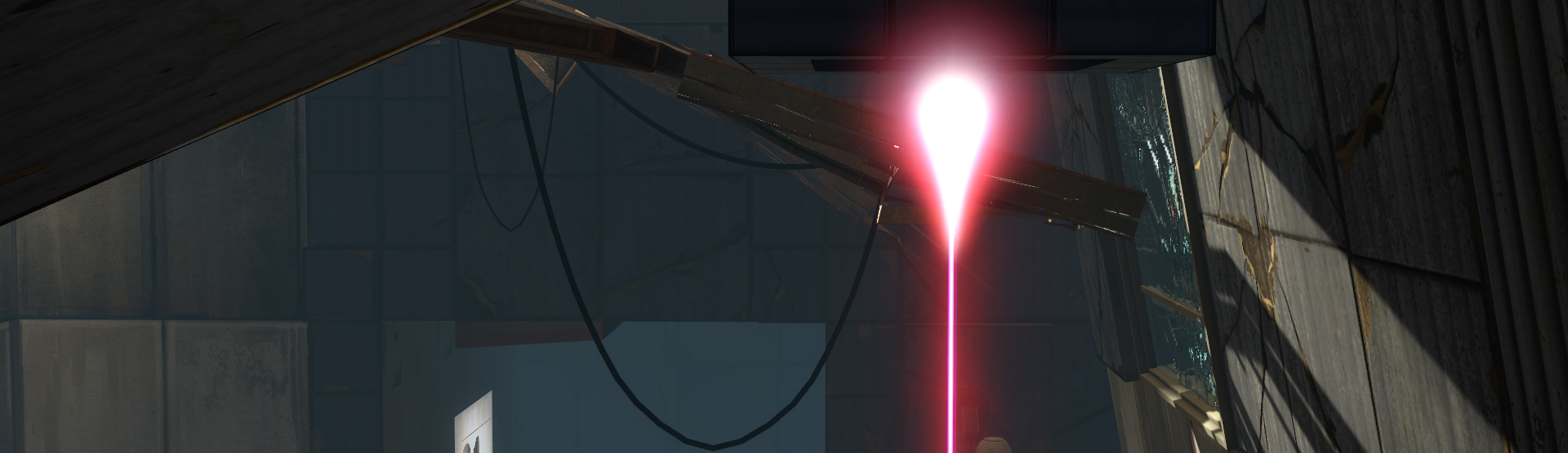
Next up is the story and the atmosphere of the game. This is a bit tricky. On one hand, the writing is absolutely brilliant. On the other? The story is lacking in certain areas. I really wanted to see how the Personality Spheres activated at the end of Portal had colonized the devastated Enrichment Center over the millenia? Instead, apart from some very vague references from Wheatley (“management”, “foreman”), there is no sign of those Spheres. In fact, there still is no official explanation for why they were activated in the first place (Portal’s ending is completely ignored, in fact). Nor is there any explanation for why, suddenly, there are Management Rails for these Spheres everywhere.
Speaking of spheres, where did the three corrupt cores at the end come from? GLaDOS doesn’t remember having them stuck on her long before her demise, nor does she speculate on why the other Spheres would have locked them in here, long after her demise. They’re just… there. Like a bunch of convenient plot devices. Another issue with the plot is Chell’s awakening. In “Lab Rat”, Rattmann says that GLaDOS’ death had blown the main power grid, and that all of the cryo-chambers were offline. So he connects her chamber to the reserve power grid, but he knows this might never wake her back up. Instead, in Portal 2, Wheatley tells us the reserve power ran out (he doesn’t mention when) and that the Center stopped waking up the test subjects. This directly contradicts what Rattman said within Lab Rat. You could argue Wheatley was too stupid to comprehend the basics of the Relaxation Vault system, but then, you could also argue that’s a very convoluted attempt to explain what seems to be a plot hole. And what of Wheatley’s test chambers that feature gels despite the fact that there had been no Gels in the entire facility until Chell had connected it to the old Enrichment Center at the very end of the second act?
There’s more inconsistencies. All of the elevators have been replaced with some sort of system that uses the Vacuum Tubes throughout the facility. It is a great idea, obviously, but there’s no explanation for it. There is no sequence in which you hear the pre-recorded Announcer talking about how the elevator system has suffered major damage, and that it has been replaced with the backup system. Instead, suddenly, it’s just there. Poof! No explanation. Then there’s also the way GLaDOS’ carcass has inexplicably made its way back down into her chamber, when in Portal, we could see her being pulled out of the chamber completely, onto a parking lot on the surface. Instead, here, she’s still connected to the chamber. Again, there’s no explanation at all. Then there’s the Cubes – even at the start of the game, when GLaDOS hasn’t woken up, the new Portal 2 cubes are being used. And that’s not all – in the game’s ending, when you’re given the Companion Cube, it looks the same as the one from Portal 1. And the Vital Apparatus Vents? Even in the destroyed test chambers, they look nothing like the one from Portal 1, and Valve doesn’t even attempt to explain that.
And what about GLaDOS? How can she still function without her Spheres, if their destruction lead to her death? How can she still work without them? And what do the Spheres do? Do they augment certain emotions and traits? Do they regulate them? What are they, Valve?
I know, most of these are all relatively unimportant subtleties. But the devil is in the details, and Valve’s games have always had incredible attention to detail, and incredible consistency between their games. But here, it just doesn’t make any sense.
Still, let’s move on to something that’s a bit more important: atmosphere. One of the reasons why Portal was so great was its excellent atmosphere. The mood, the ambience, whatever you want to call it – it was there. You constantly felt alone, almost afraid. The only things you could hear were GLaDOS’ passive-aggressive remarks and the ominous noises produced by the Enrichment Center itself. Observation rooms are placed throughout these chambers, but there’s no one up there. Then, she tries to kill you, and you escape by fleeing into the bowels of the facility. Here, you’re still alone, and you’re still in danger. This time, GLaDOS can’t see you, and you can’t see her, but she’s still trying to kill you. But grim solitude was not the only element at work here. There was also GLaDOS’ brilliant dark humor, penned by Erik Wolpaw of Old Man Murray. Simply put, it was Valve, at their finest.
But in Portal 2? Within the first 5 minutes of the game, you meet Wheatley. Make no mistake, he is hilarious. Well written, well voiced – he is one of Valve’s greatest characters. But does he really fit in Portal? The opening of the game had a lot of potential – wandering the devastated corridors of the Enrichment Center, the real world and the sun somewhere above you, beyond the fractured ceilings of the test chambers. Instead, most of the opening is spent on Wheatley. His colorful jokes are hilarious, but they damage the game’s emotional integrity by placing a firm emphasis on silly comedy that bears no resemblance to the original game’s dark humor.
The second act also had a lot of potential. You’re kilometers underground, in the dark, enormous abandoned sections of the Enrichment Center. Who knows what could be lurking down here? Who knows why the place was locked down? How will you get back up? It really starts to resemble Portal 1 a lot, but then you meet GLaDOS. Who is now inside a potato. The atmosphere is, yet again, torn to shreds, because GLaDOS talks constantly. She yells at birds, she starts talking about how sticking her onto your gun just gave her an extra 0.5 volts, and so on, and so forth. It just ruins all of the potential this sequence had. Maybe if GLaDOS had been a bit more passive-aggressive, then that would have worked! It would have resembled Portal 1 even more. But instead, GLaDOS seems to be oddly… nice. Granted, she is now vulnerable, and weak, and this is, for the record, a great evolution point for her character, but they could have done so much more by handling the whole thing in another way. Having her not trust the player at first, delivering a few light passive-aggressive quips to illustrate that, mirroring her personality in Portal 1. But we don’t have that.
That’s not all I didn’t enjoy in the second act – there is no ending to the Old Aperture story arc. It just… goes away. There’s no scene showing GLaDOS’ creation, there’s no scene showing Cave’s passing, we don’t even get to see his grave. Imagine how amazing a scene that would have been. On top of that, most of the environments in Old Aperture are very strange – they say these test chambers were built by humans, but apart from their art style, they are completely identical to what GLaDOS builds. They are just as infaillible, and just as malicious. There is no difference between them. And the environments themselves don’t seem to make much sense. They aren’t even explained at all – what was the Tartaros area? What was Test Shaft 09? Where were all the other Shafts? Where were all the other Enrichment Spheres? What was sealed off in the 1960’s?
And the Half-Life references? You just get Cave suddenly implying Black Mesa stole from him in the 1970’s. Then you see trophies showing that someone, presumably Black Mesa, beat Aperture for DoD funding as early as the 1940’s. Before the ICBM facility where they were based was even built. And then you see an empty chamber that should be villified. The solid bulkhead door has been blown right out of its hinges. What’s inside? An empty room, with life-preservers saying “BOREALIS”. It’s not the infamous drydock from Episode Two, because the room itself seems to be completely intact. So then what is it? It’s a very poignant sequence, but it seems… unfinished. Like all of the other Half-Life references in Portal 2. Unfinished. Doesn’t Half-Life deserve better than this?
That’s not the only sub-plot that’s left unfinished, but still thrown in the game. During the “Bring Your Daughter To Work Day”, the one potato that has grown into the ceiling bears Chell’s name. The words that came out of my mouth upon seeing that were: “what the fuck is this supposed to mean?”. What is Valve trying to imply? That Chell was a child when GLaDOS began her takeover? How on Earth did she grow up when she was in stasis? Did someone raise her? Why would anyone let such an important plot point so widely open, in a game series that might not see a third installment by 2015?
Moving back to the second act – I believe it could have been so much better if it was bigger, longer, and more in-depth. I also think that the reunion with GLaDOS should have been postponed to some point later in the act. I would have loved to explore the labs, take a look at their disturbing experiments, find out more about Black Mesa and Aperture’s rivalry. I wanted to find out more about Aperture, especially since Valve has gone through the trouble of retconning so much of the original Portal 1 backstory (another immersion-breaker for anyone who still remembered Portal 1’s great backstory). But we don’t get any of that. The whole second act just seemed so rushed – like Valve wanted the player to get back to the bizarre comedy as soon as possible. And the player eventually does – just look at the ending. It’s the most outlandish moment I’ve ever seen in a Valve game. They did say we’d get a look at turret culture, but I didn’t think they meant this.
On the whole, I think I would have wanted to see far more Behind The Scenes levels. In Portal 1, these atmospheric levels made up half the game. In Portal 2, they barely make up a quarter of it. I think Valve is starting to underestimate the value of pure exploration sequences within a video game.
But also important to atmosphere is immersion. In Portal, the immersion was as strong as it had ever been within a Valve game. But in Portal 2? The immersion is broken several times – when you notice that Chell looks completely different; when you realize that somehow, when she was in cryo-sleep, she took her top off and tied it around her waist; when you see Chell’s hands squirming about of their own free will during the ending for no apparent reason; when you notice that you can’t actually move the camera when GLaDOS is giving her final monologue; and, finally, when Valve decides to put the entire ending inside BINK video. And let’s not forget those little L4D-style indicators that pop up in the opening, no matter how many times you’ve played the game. They even make a sound. You can’t turn them off. At least in HL2 and the Episodes, they were to the right of the screen. They didn’t get in your way. Even the chapter titles seemed a bit overdone – the font was enormous, and the things were even numbered! Then there’s the portal ghosting, inspired by L4D’s player sillhouettes. Again, you cannot turn these off, and they get irritating as well.
But the single greatest affront to immersion in Portal 2 are the obnoxious loading screens. These things take up the whole screen, just to show you the Aperture logo. They make loading seem much longer and more frequent. What happened to Portal and the Half-Life games’ subtle loading screens? I’m sure using those would have probably saved some loading time. Those at least leave you with a view of the game world as it’s loading.
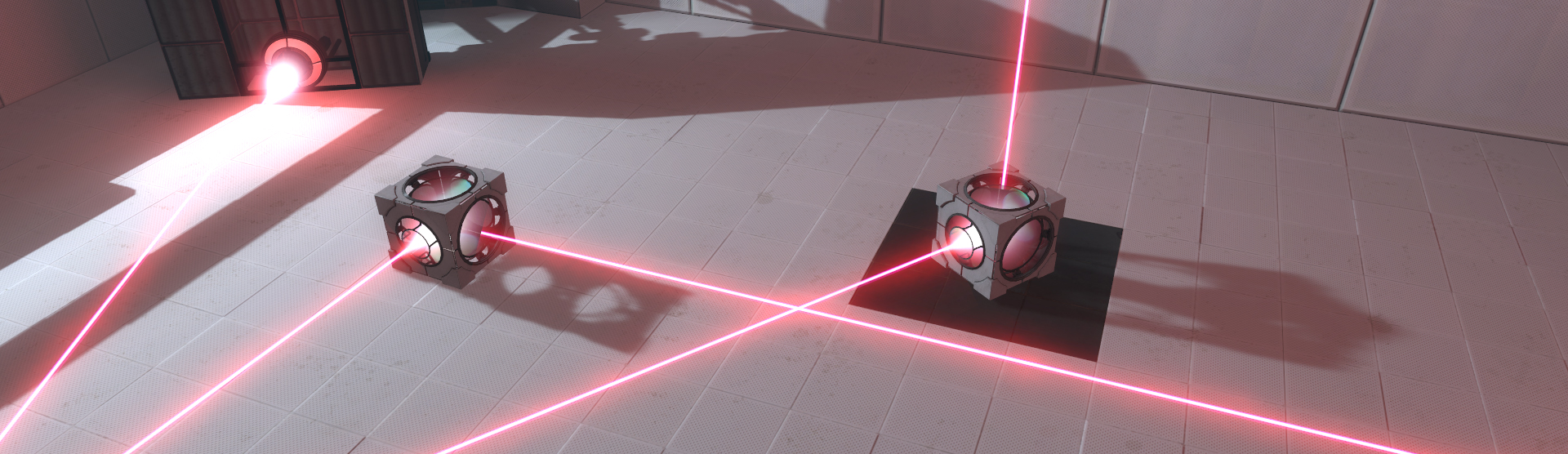
And finally, there’s the sound design. While it is great, again, it just doesn’t stand up to what we saw in Portal. I don’t know if it’s because of Kelly Bailey’s absence or the fact that they’re using some new dynamic sound system. The ambient sounds are great, but they never made me feel afraid, isolated, like the sound in Portal 1 did.
As for the soundtrack? Well, I enjoyed it, of course, but it’s nothing compared to the soundtrack of Portal 1. Each song in Portal 1 was distinctive and memorable, with its own sound. Each song fit the mood, emotion and atmosphere of what was happening on-screen perfectly. In Portal 2? Most of the soundtrack isn’t very distinctive at all. After a few chapters, it just started to sound a bit repetitive, almost mundane. Maybe the dynamic music system did its job and everything blended into subtle background noise. But is that the point of a musical soundtrack? I don’t think so. The few songs that stand out either aren’t subtle enough to fit with what’s going on when they’re being played (a no-no in my book) or aren’t even in the game at all. Say hello, “Science Is Fun” and “Reconstructing Science”.
Then there’s also “Exile Vilify”, a brilliant piece created by The National exclusively for Portal 2. It is inexplicably banished to a Ratman den in the early chapters of the game. You never hear it anywhere else. Not even the credits. Instead, the credits speed along at an incredible speed, while “Want You Gone” plays in the background. I’m sure they could have squeezed Exile Vilify in there. To avoid boring the player, they could have had some concept art be displayed alongside the employee names. While we’re on the subject, I will admit that I absolutely loved Want You Gone, and I personally believe it is better than Still Alive.
So to conclude – what do I think of Portal 2? I think it’s a brilliant title, and it is definitely among my all-time favorites. But I think it’s a bit of a stretch to believe that it’s superior to the original. In some departments, yes, it is. But in others, it falls significantly short. And for Valve’s first singleplayer game in three and a half years, for a game they themselves were calling their best game ever, for a sequel to one of the greatest games ever, and for a spin-off to one of the greatest shooter franchises ever that hasn’t seen the light of day in over 4 years, it’s disappointing.
It almost seems as if, in an attempt to make the game simple to play and enjoyable by all, Valve might have simply… sucked the life out of it. Everything in the game is a cue, or an attempt to steer the player away from all other gameplay possibilities and push him/her towards a scripted conclusion. They’ve turned it into an on-rails adventure – an interactive film. Valve has put so much effort into that scripted path, that they’ve neglected all the other ideas they had, and all the other ideas they could have had. They’ve even neglected the game itself, which is why you’ll see nonsensical level layouts and bizarre mapping problems – as if Valve expected you to NOT look at them, and instead look at… well, whatever the director wants you to look at.
Ultimately, the question of “is Portal 2 better than Portal 1” is up to opinion. But I think the question of “is Portal 2 a faithful and worthy sequel to Portal 1” might not be up to taste – it relies on facts. And while Portal 2 is an incredible game, it doesn’t seem to live up to Portal as a sequel. Would I have taken F-STOP over the Portal 2 we eventually got? I’m not so sure, but I must admit that F-STOP seemed to have that same dark tone and atmosphere that Portal did. And imagine how much of a surprise it would be – a new Portal, without portals. While it would have been risky, Valve has always been a company that’s willing to take risks to reap the rewards.
In any case, I would have gladly welcomed Portal 2 as a worthy successor to Portal 1, provided Valve had given it another half a year, maybe around 7 months (meaning February to September, perhaps even more than that) to really develop it into a bigger, and better game. Has Valve lost their touch? I’m really not all that sure. I don’t think so, personally. But none of us can say for sure, especially since it’s too early for that. But let’s hope they haven’t, and that their next single-player title will be a worthy follow-up to a great franchise. You know the one I’m talking about.
Peter Bright of Ars Technica ended his critique of Portal 2 by saying that 2011 would be a very bleak year for gaming if Portal 2 won Game of the Year, the same accolade that its predecessor won 4 years ago. I end my critique of Portal 2 by saying that 2011 will be a fine year for gaming if Portal 2 wins Game of the Year, but that it will be a very bleak year for the Valve fanbase if it is the year that establishes Portal 1 as some sort of metaphorical red-headed stepchild that is inferior to its sequel in every way possible, and the year that establishes Portal 2 as the finest game Valve has ever produced.



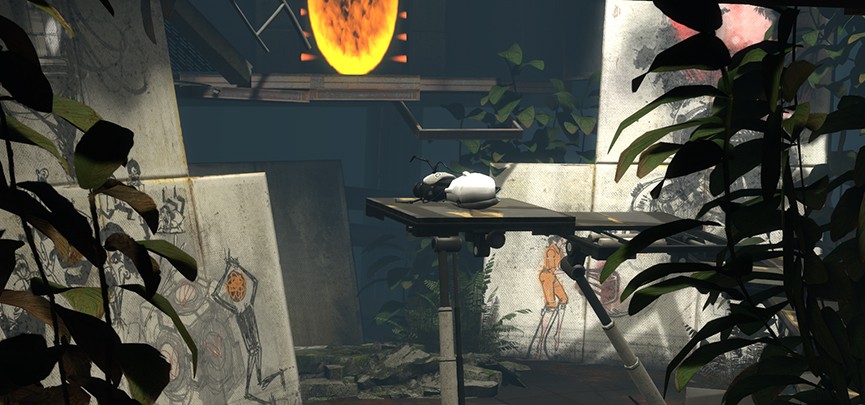
While I’m really late here 😀 I want to add my 2 (euro) cents…
saying that I am deeply disappointed with Portal 2. To the point that I feel almost “painful” playing it, it feels a bore to me, and I’m hoping it will end soon (could I stop playing? Yes I could. But I like finishing stuff – I’m OCD that way ;-).
In a few words, I find Portal 2 boring, extremely linear and soulless.
Level after level, test chamber after test chamber, there’s only one way to go, one solution to the puzzles, and nothing to discover or stumble upon (save for some minor Easter eggs). It’s like a giant “connect the dots” game: the dots are neatly drawn, you only have to connect them.
Yes, some puzzles are hard (to me, at least), but I cannot see creativity there because once you found THE solution, it’s the only one possible. There’s no point in experimenting, or looking for alternate ways.
In one word, it feels like a drag (though I admit it gets a little better and a bit more creative with the gels).
Lastly, I loved GlaDOS mean personality in Portal 1. While here I find Cave’s comments funny and quirky, they’re way less entertaining and unique than GlaDOS one-liners in Portal 1.
I see I’m in the minority, and it’s fine. It’s all subjective.
But Valve, oh Valve… what have you become?
Well Vic, You are correct. I finished my first play through today and you hit all the feelings I had on the head. The game made me feel like an idiot in a lot of ways. Very funny stuff in it but mostly just stupid happy go lucky humor and linear gameplay.
Great game, not the same caliber as the first.
Though the part about HL references is completely pointless because Chet did say Portal 2 was planned to make the series a completely separate IP, divorcing it from HL. The things that were referenced were just fine to me.
Thanks!
Actually to be honest, I agreed on basically everything you said, I always criticized games to depth, not because you hated it, but because you’re trying to make it better and give your opinion.
Although I think any game might lose their charm after 10 playthroughs, and you’ll start to notice stuff that you didn’t the first time, I don’t know, it happen to me a couple of times.
Any game has graphic glitches or somewhere there is lazy level design, no game is perfect ever.
The parts you lose control of your character didn’t bother me much because I felt like the cinematic feeling was still there, and also it’s not like the entire game play was at all interrupted by game videos or ‘different perspective views’ all of a sudden like most games do, it still pretty much felt like a Valve game.
They only had one video during the gameplay and it was at the end of the game, this did concern me, and I hope Valve does not move into the direction that most video game companies do by overdosing there games with videos at the end of every level.
But then again, this isn’t Half-Life, Valve has to take different styles of gameplay and different feelings and approaches to different variety of games otherwise they’ll all start feeling like Half-Life’s style.
They didn’t apply this to the first Portal because it was really actually just an experiment game so far I know.
I noticed the storyline hiccups as well, how was Glados able to reboot if you destroyed all her cores during the first game? And could a high end AI machine core fit onto and get powered by a potato? Now I was never good at science but that felt a bit unrealistic, but it was defiantly funny.
And the isolation of the game wasn’t entirely as good as the first but Portal 2 still did it nail on good, maybe even better on certain areas like the old parts of Apeture Science, that entire area felt creepy and utterly deserted, I thought they did the isolation damn good there.
If you didn’t feel it at first, the amount of game time you’re down there would eventually give you that feeling of abandonees and some sort of claustrophobic.
Also I thought the fact that they didn’t add almost any information about Apeture Science past was a good thing, that’s typically Valve.
It wouldn’t be very atmospheric or isolation if you went down there and founded out everything you always wanted to know about the place, it’s the idea of not knowing, the ‘unknown’ that made the atmosphere when you entered that place and when you left it, still not knowing much, it will most likely always remain a mystery, I thought they did it explicable well and it’s a good trick that Valve does in all there cinematic games.
I think maybe a lot of the stuff Valve didn’t explain ‘why’ was to give you the opportunity of imagining yourself, giving you the chances to fill the gaps yourself, it wasn’t suppose to let the player down, I think it was suppose to give the player the creativity of thinking up themselves reasons for why certain stuff happened.
I think most of the stuff we think are glitches, are actually planned by Valve themselves and they wanted the audiences to use their imagination instead of giving us entire introduction to every single thing.
I have to admit I think some of them really were errors, but I think Valve is far more serious about their games than we think, that’s why each one takes so long, each one of their games are true unforgettable experience that they try to achieve every time, especially the cinematic ones.
In my opinion, I thought they did Portal 2 better.
On basically everything else, I agree with you.
I didn’t like it either that they took away the physics in most of the objects, you couldn’t pick up almost anything anymore which was sad, even though you would never be able to use those stuff, it would still be a nice thought to know how alive the world is.
The game felt more open for me this time around with the huge environments the Source engine could render now with its sexy graphic, but the ways to solve the puzzles did feel more linear this time around, I think Wheasley even made a comment on that almost around the end of the game when you were looking for his chamber.
The traditional Valve loading screens was defiantly the best, even though it’s a different game than Half-Life, this should have still stayed in the game because this always made it feel like you never left the world and didn’t break the game flow.
I think Valve was anyway trying to move away from the horror and creepiness of this game, they were going for more gameplay, comedy, and joy this time around, I think every game company sometimes need a variety of games.
I heard anyway Gabe Newell is planning on doing some serious creepy crap in the new Half-life 3 or Episode Three, now with that new Valve intro, I think there planning on doing some really weird stuff in there new game, stuff that will actually mess around with our emotions like they did at the end of Episode Two.
So if you’re looking for that old great uncanny gameplay style and feeling they had in Portal 1, rest no more, they’ll most likely do it in the next Half-Life by tenfold.
I can’t wait I’m so excited 🙂
Wow, do people seriously believe Portal 2 was “short” and Portal 1 “long”? (self.gaming)
submitted 28 seconds ago by NonAmerican to gaming
commentsharesavehidedeletensfw
This is a clear case of the childish “I was a noob back then but I’m yet incapable of seeing that now I’m more experienced”. I see that in WoW all the time. People that insist “Vanilla was hard” when most bossses would be nowadays totally puggable. People back then simply had no idea how to play the game. Hell, even Blizzard didn’t know the direction of the game yet.
And Portal 1 being a “long” game? Lol. Seriously, not only Portal 2 is longer to complete but it felt about double the time.
Sure, it could be longer but calling Portal 1 long is laughable. It has just harder for you because you had no idea how to play it at the first levels.
Fun fact – at no point during this entire article did I call Portal 2 a short game. Nor did I call Portal 1 a long game. You sure you’ve got the right website here?
Thank you for writing this article. It’s good to have some engagement, and I’m sorry if you’re having to deal with some emotion from other commenters.
I do agree with a lot of your points—in particular, I wish they dealt with ApertureScience.com’s history more gracefully. And the game is FAR too easy.
Two things I disagree with, though—things that I believe are factually wrong, or at least suspect, when you say they’re “objective.” When you claim to have that, expect people to scrutinize your words over what is really true, and not just what different values we have.
One disagreement: level of detail. You make an “objective” claim here: you say that Portal 1’s settings will seem more detailed (to most people, presumably) than Portal 2’s. This can indeed be an objective claim, and it makes an objective prediction: if you force random people to play the games and make them rate their levels of detail, Portal 1’s detail ratings would be significantly higher. THAT would be good evidence for your objective claim.
But your evidence is that you find Portal 2’s environments soulless, that there aren’t as many doors, and that you can’t pick up many objects like you could in Portal 1 (admittedly an unfortunate change, though perhaps not as big as a deal as you’d think). This is a true fact, since it’s about your state of mind. This is also very weak evidence for your “Portal 1 is more detailed” claim; as it is, a single data point, I don’t think it justifies it, objectively.
In fact, let me give another data point: I think Portal 2’s levels are much more detailed than Portal 1’s. Don’t even talk about the Neurotoxin Generator; that was actually one of the worse-detailed levels. The revelation that the Enrichment Center is a massive hollow building with myriad panels and tubes, and that Test Chambers are really thin, moving eggshells, and how they integrate these new facts into how Wheatley smashes together chambers—and the posters, signs, and chipped paint of the stuff below—and the plants threading through the flapping panels in the sunlight above—and the way the Test Chambers would move, groan, repair themselves, and disintegrate in the end during the beginning and ends of the game.
—compare this to Portal 1’s, which had stuff Portal 2 has, only it’s all sterile or rusted but always frozen (ignoring the pistons), plus a single slideshow (which was very excellent though) and a couple of derelict, same-y offices with Turret Cores.
Two: music. This isn’t an objective claim; there’s no evidence, except for a guess that it’s “worse” because the music’s dynamic.
Let me say that I love much of Bailey’s old music; “Tracking Device” and “Apprehension and Evasion” remain excellent. But his Portal 1 music (except for 4000 Degrees Kelvin, which actually develops!) bores me.
Portal 2’s music has some tracks I don’t find interest in (“Music of the Spheres” is too long), but others—like “I’m Different,” “The Friendly Faith Plate”, the Wheatley Laboratories pieces—actually have interesting melodies—far more interesting than Portal 1’s. Plus, the music actually has RECURRING THEMES. It actually has LEITMOTIFS, like that recurring horn phrase, or the recurring Turret Opera phrase, and so forth. This alone makes it much superior in my eyes.
Bailey’s Half-Life music is good. His Portal music? Not so much.
But of course, that’s my opinion, depending on my values. It’s just one of the two things I disagree with you. Again, thank you for writing this article; it’s always good to read stuff from people different from you.
For the detail area, I was talking about environmental, interactive detail, although I might not have made that very clear. Not level detail as a whole. I don’t see why it’s not an objective fact, and I don’t see why it’s weak – it’s an objective fact that in terms of interactivity and enviromental detail, Portal 2 is lacking in a few areas. However – on the whole, what you think about the level detail is up to you, and that’s obviously a subjective idea.
As for the music – I imagined everyone could realize that was subjective, and that it is based on my own opinion. It’s interesting that you mentioned the leitmotifs and melodies, because I’m not so sure if those fit very well. Portal 1’s soundtrack was much more interesting – it felt and sounded almost alien. At the same time, it sounded absolutely incredible. It might not have had recurring themes or leitmotifs, but are those the things that make a soundtrack good? In your eyes, perhaps. But in mine, not at all.
Still, I’m glad to see you liked the article!
This is it
It’s April 19th. I finished preloading the game a few days earlier. I hook up my stereo system. I carry a 32 inch full HD OLED display across whole apartment to my PC. I go offline from my steam friends. I dim all the lights and I sink in my chair. I’m ready…
… but I don’t start the game right away. I wait. I stare at the Google and ask myself: »Should I check some trailers, interviews, previews or any other portal related media that I’ve been avoiding for over a year now« It was a hard work since I really enjoy following gaming journalism but it’s the price I had to pay for my spoiler-fobia. I decided not to check anything but I still didn’t go in the game. Suddenly I don’t feel the urge to play it. There was some kind of doubt or uncertainty in the air that I can understand only now after some time has passed.
The problem was… I was moments away from going in to the Portal 2. The first true single player game from Valve in god knows how many years. The sequel to the best fucking game I ever experienced in the recent years, maybe even in my whole life. And though I braked in to the background of Aperture Acience and eventually got out. I always felt that I was only seeing the tip of the iceberg. And I could only imagine what this whole place was. Story vise the game did a lot by just giving you very little information over all. Your mind and imagination kind of filled the rest.
And now I’m one click away from starting the game and I’m asking myself. “Should I just forget everything I hopped and imagined aperture science could be? Should I just accept that other aperture story, the vision the atmosphere that some valve designer or writer imagined”. I’m not sure, but it’s to late now. I’m starting the game and the screen is going black. This is it.
I’m in
I wake up in a motel room, do some exercise, watch some art and go back to sleep. I wake up 9999… days later. Everything is rotten and there is a robot with English accent knocking at my door. The tone for the whole game is set in this first few minutes . I’m surprised how non Portal it feels but I can’t help to stop enjoying it.
I never understood why people described first Portal as the funniest game ever or something like that. For me Portal was basically a horror/mystery game. Sure it has solid humor but I just can’t describe it as funny when you are walking alone in giant deserted halls, escaping death and listening to some kind of dark, electronic, drone music as a soundtrack. The first thing I could think of when describing the tone or atmosphere of portal was the 1997 move Cube (I really recommend it).
Suddenly the whole world around you starts collapsing and the first peace of soundtrack kicks in. I take a few steps back for safety reasons and I witness quite possibly the best opening scene I’ve seen in years. It also hints at that other non comedy tone that game has to offer. Later on I see old chambers that are barely recognizable. The portal gun looks different, it performs and sounds different. Generally a lot has changed. Was I expecting it? No. Does it look or feel like Portal? Not at all. But there is this freshness and charm to this new art design and world that just doesn’t give me chance to ask myself this kind of questions. It just sucks you in with very first opening scenes and I just go with the flow.
Portal 2 tones down the isolated horror feeling and cranks up the mysterious and funny side. I never saw it coming but it’s there and I found myself really laughing this time. It’s not just the situational, character comedy that works for me. The press space to speak »apple« is just mocking the »press something to do something« element we’ve seen in almost every game ever made and the Cave Johnson’s hats statement even brakes the 4th wall in some way.
Twist and Shout
Not long ago after meeting Wheatley I found myself thinking. »I really hope he doesn’t turn to be the bud guy, that would be the cheapest twist ever«. But he does. And somehow it doesn’t feel cheap. Maybe because I really liked him and we’ve been through a lot together before it happens. I helped him and he helped me. There is a bound and it adds some depth to the twist of the character. And when I was thinking that I’m just seconds away form escaping aperture labs it all happens. It’s Stephen’s voice acting at it’s finest when he shouts and beats you to the hole. Later on I feel stupid for actually liking Wheatley so much, I realize that I was actually hating Glados and that I don’t hate her so much now that she’s so weak, but I still don’t trust her till the very end. And just the fact that I find myself thinking about this relations proves how strong the characters and the whole immersion was for me.
The twist goes on. Suddenly I am in cave and I have no idea that I’m going beyond the background that I saw in first portal. The whole world and art design reinvents itself when you stumble through old aperture labs. It’s a classic mystery »box within the box« effect that triggered that basic human curiosity on every corner at every door. That excitement of opening that large vault door was something I haven’t felt since watching Lost (the hatch scenes). The loading screens can’t break or even disturb the curiosity and immersion that is this strong.
»I’ve seen things you people wouldn’t believe«… but the graphics engine broke my immersion.
I’d like to remember everyone that I haven’t seen any trailer or gameplay and nothing Portal 2 related before going in. This means, that I could maybe be able to write a review without mentioning the word »marketing« or »hype«. But who would want to read that any way.
The way I see it it is your job to know everything and to know it as fast as you can. You have to double check everything, read some forums and collect all the bits from everywhere before turning it in to interesting to read valve related news or story. I tried to do some research of what I missed after I finished the game but there was way to much stuff to go through. I can only assume you probably saw this things before the game was released:
– The opening scene
– Wheatley
– Cave Johnson
– the Glados awakening scene
– the Cave Johnson chambers
– the gels and how they work
– the tunnels, lasers, hard light, and air vents (that were not in the final game)
And the Potato sack event. What an interesting concept. I can see how some people might have worked a bit to hard and expected a bit to much from all this.
I can only imagine how it is to go in to the game when you saw such a big portion of what is awaiting of you. When I first saw a the gel it was a uprising visual and sonic experience at first. Then came the learning process. If I knew all the new mechanics from the videos before the game I might feel different. Maybe I wouldn’t be surprised at all when I first saw them and I might think the beginning lessons were just useless because I saw them already and they didn’t teach me nothing new.
And meeting all the characters that I already meet in the YouTube videos before. That would probably ruin the whole experience a little. And loading times could get annoying if I would be waiting just to replay some scenes I already saw. I would probably get a little bored and start paying attention to other stuff that’s just happening between things that I already saw. Maybe I would have even notice this:
http://lambdageneration.com/wp-content/uploads/2011/09/sdddd0r3j.png
Where is the magic?
I don’t think you can fully understand how some one might feel about Portal 2 if you don’t know how they felt about the first Portal.
I remember it looking a lot like Half Life 2 from the main menu in the first time. The Portal gun kind of looked like gravity gun and the whole soundtrack sounded Half Lifeish. It almost looks like they did it on purpose so they could catch you of gourd later on. Not long in to the game you start to realize that there was something more to it. The Glados started to act and say weird things, I was constantly prepared for someone else to show somewhere but it never happens. I’m alone in this. And then the moment you first saw »the cake is a lie« graffiti and when you escape the whole thing, and when you realize it’s all happening in half life universe. A lot of heavy and cleverly executed stuff for what looked like a half life mod not to long ago.
Portal is like a magic trick. The magicians comes to you with ordinary objects and does something amazing with them. You see it and you are amazed. You see it a few more times and you start to understand how it works. Than the magician comes back in town after some years. And what does everyone want to see? The good old magic trick everyone loves. Magician knows to well they don’t actually want to see the same trick. They want the same effect, the same excitement. To do so he needs to catch them off gourd again.
Maybe we are to old or we’ve seen to many tricks done on to many ways. That’s why you need take a step back sometimes and give game a chance to impress you in it’s full glory. I encourage you to try to avoid promotional videos, trailers, interviews, screenshots and just go in not knowing anything. It’s how it was meant to be experienced in the first place.
Nice little comment, but no, I don’t think I should avoid promotional “videos, trailers, interviews, screenshots” to experience it as “it was meant to be experienced in the first place”. Because that’s not how it was meant to be experienced at all.
Because no matter what company or game series we’re talking about, I, and many other gamers such as myself, will not spend $50 on a game “not knowing anything” about it.
It has nothing to do with writing for a fansite at all. You see, Valve makes their promotional videos and content. Not some unseen boogeyman who wants to spoil the game for us. Just Valve. And when they make all this promotional media, they make sure it won’t spoil the actual game itself. Because they know that no one’s going to throw $50 at a game without knowing a single thing about it.
The biggest problem with your comment, however, is that you seem to have missed the entire point of my critique. In addition, you make some very unreasonable assumptions about what I felt when I was first playing the game.
You see, what I’m talking about in my critique is “why Portal 2 is unfaithful to Portal”, NOT “why Portal 2 is a bad game”. Because it isn’t.
I’m glad Portal 2 had wheatley to keep me company. I’m sick of games where you spend the majority of your time either completely alone, or killing so you can be. I’m happy valve is doing away with the “isolated single-player experience.”
I loved Portal 2 because it wasn’t what I expected it to be, the same reason I loved Portal 1.
I think you suffer from nostalgia a little bit too much.
It’s pretty much the dream sequel, it improves in pretty much very way, unlike those other sequels these days which are pretty much the same thing. At least that’s what I think.
Oh and all the little details that were ‘incorrect’, just because they don’t say something happened doesn’t mean it didn’t happen at all.
I’m not saying it’s a perfect game, but in my opinion you don’t do it justice with your mocking on it.
I think you suffer from “rose-tinted glasses” a little bit too much. I don’t think it improves on it “in pretty much every way”. And no, if they didn’t say it happened, then I don’t count it as canon. Nor do I think I was “mocking on it”. Hardly – I was being critical. This is a critique, after all. I think I did the game justice.
😛
Don’t get me wrong, you wrote a great article and I respect your opinion.
But after reading your sort of review, I’m just left with this feeling that you think, ‘Portal 1 was so great and if they’re even going to change one single thing, i’m gonna…’ . But oh well that’s just my opinion.
But about the improvents in every way (all opinions): bigger, better story, better level design, more attention to detail, more and better characters and more gameplay elements.
You are right however if you say they simplified the puzzles quite a lot, I still don’t get why they didnt build all the testing rooms entirely out of white plates..
Oh and the variety in gameplay and level design is great.
And now about all the little differences between the game, for one it is set hunderds of years later and for two it’s in entirely different places in the aperture laboritories, something Valve even said, don’t know where though.
I think all of your arguments are well put except for your lack of detsil argument. I do kinda wonder if you even payed attention while playing through it. I was totally overwhelmed by the ammount of detail. Those ratman caves where really amazing in my opinion.
Yes, I did pay attention while playing it. The article states I have played it around 10 times, and that’s true. I didn’t feel that there was that much detail. The Rattmann dens were well done, but they were among the few detailed areas in the whole game.
And no, I don’t really think that “if they’re even going to change one single thing, etc”. I just think that if Valve is going to do a sequel to Portal, they should do it right, not completely alter the game’s tone, level design and story.
Completely alter the game’s tone, level design and story?
Completely…?
Let’s just end our argument here, it’s obvious this isn’t going anywhere.
The problem at least with the story elements, retcons and inconsistencies is that Portal 1 wraps up perfectly and really didn’t need a sequel, your character who seemingly destroyed the AI is left to die or run away from the facility and the player feels they accomplished something. After which a song plays exclaiming how the AI is actually “still alive” and that you accomplished nothing, if anything the AI which was dedicated to scientific pursuits actually had foreseen this possibility and has noted it as part of a learning experience. It fit the theme and the atmosphere of the game perfectly and didn’t need a sequel.
I totally agree. The loading screens, the retcons and the silly humour were the worst parts for me (still a brilliant game though). In terms of atmosphere and puzzles the co-op was superior, although it’s hard to have “immersion” in a multiplayer game.
too long. did not read. lol too tired to read more like it. but ya i understand your views and would mostly agree with you that portal 1 is better in many ways. but for me i consider portal 2 just a continuation of the portal 1 story and hold both as just the portal game story. i regard half life 2 games in the same way where they all are just one long continuous game.
No Kelly Bailey ;( Valve needs him he has been with them since the beginning none of Valve’s games will be the same without him.
Also it’s not as dark as portal 1.
Good review. Portal & Portal2 mirror Star Trek (TV series) and Star Trek: The Motion picture. Nearly all the magic that made the original ground breaking and beloved was missing from the sequel. It was like the team who made Portal 2 didn’t Get it and striped out what so very cool rather than building upon it and making it even cooler. P2 may look better and contain new cool stuff, but there is no mojo factor in the single player game.
I do have to agree on most of the parts.
Even though i LOVE Portal 2, i kind of agree with a few of these points.
I would of loved it if the game had been a bit darker, as Aperture is pretty crazy yet most of the stuff they did was humorous instead of Dark.
Seeing more behind the signs and personality cores would have been great. As for the cores, they were there because they were defective cores – they could have been in there for a LONG time but as there was no GLaDOS nothing was done about them.
The Elevators and things were retconned. Same with the Management rails and things, they were meant to have been like that the whole time.
The Cutscene did annoy me. Loading screens not so much as we got to see some nice stuff.
The portal 1 ending was not completely ignored, the Personality Spheres activated because GLaDOS was destroyed.
By ignore I meant the Portal 1 ending (the infamous cake scene) wasn’t acknowledged in any way apart from Wheatley’s appearance. As for the elevators and other things – I realize they were retconned, but Valve could have done it differently to at least have some sort of consistency.
I agree with you, Vic.
Portal 2 is too linear to be puzzle game. It’s an adventure game. White surfaces act like red crosses above the turrets in Portal. Portal 2 appears to be intended to be watched instead of being played. Like many modern games. Portal is a breakthrough in gaming. Portal 2 is yet another mainstream game. Valve should hire new indie game developers who still have original ideas.
And I miss Portal music. It gives me a feeling of waiting for Portal release and playing Portal for first time. I want 2007 back…
I can only disagree with “There’s more inconsistencies” section. It’s been a long time between Portal and Portal 2. Aperture upgraded or changed most of their stuff during this time using personality constructs. But Valve did not give a feeling of the time passed between P and P2. I haven’t seen any real upgrades in Aperture technology. I even saw downgrades in some places. Portal elevator was on tractor beam, while Portal 2 elevator uses vacuum tube, which is an old technology.
And Valve must remove Transmission Received, Valve promos ruin their games.
Well, the thing is they could have at least expressed that within the game with Wheatley or the test chamber Announcer, but they didn’t. So it has no explanation within the game.
I think one of the things that made Portal 1 great was the fact it was an amazing stocking-stuffer to the orange box, so many of the resources for it were reused or very minimal, forcing them to be very clever in the way they handled the game experience.
I feel that Portal 2 was handled more cinematically.
I agree with this review or critique of Portal 2, though the HUD and menu stuff didn’t bother me all that much.
Honestly when I go back and play Portal 1, it feels like a completely different game, and I don’t like it as much. I think Portal 2 is MUCH better, but I can understand why people like the first one better. I guess. Maybe. Okay no, I can’t, Portal 2 is fucking amazing.
To be fair, a lot of the claims you make are not objective. For example, I was never *afraid* in Portal 1, so I don’t understand what you mean about there being a lessening quality in the sound editing from one game to the next. To me, Portal 2 was an interesting exploration of an interesting (if fanciful) world that was incredibly well done.
And the story elements you picked out are nitpicks, too (inasmuch as there was the robot who took care of Chell who may have taken care of GLADoS, the Black Mesa Corporation may have existed long before the BMRF was established, and so on). Of all the things you mentioned, though, the elevator thing REALLY bugged me, but I didn’t let that get in the way of the arc I was discovering.
If the game did live up to your expectations, that’s one thing. But there are no objective parameters that support your opinions on a game. In cases like that, you can only rely on “I don’t know art, but I know what I like” reasoning, and leave it at that.
I think what he meant with “afraid” was that you got the feeling of being in complete solitude, just you, a portal gun, and a what seemed to be an automatic response system. You got a cold feeling. Where did the people go? Why isn’t anyone made of flesh observing you? And then it was the Rattman Dens, who helped in making you feel so alone.
That is what’s missing in Portal 2.
not always, in the 80’s places and the turret factory was pretty lonely
Nnnot entirely. you KNEW you weren’t alone in Portal 2, with all the chirping taters, cores, etc, whilst in Portal you didn’t have a clue if the voice was from a sentient being or just automatic. You just complied in hope of getting an answer why there weren’t any humans present in the game.
In Old Aperture you had PotatOS right by your side. You were really not alone. As for the turret factory – it was one of the few moments that reminded me of the good old Portal 1 BTS levels, but then, didn’t we have Wheatley pestering us during that sequence as well?
I’d say most of my claims were completely objective. Only one of my conclusions is subjective – “Portal 1 is better than Portal 2”, for example, is completely up to opinion. But I’d say the rest is fairly objective, including “Portal 2 is not a faithful sequel to Portal 1”, because as this article illustrates, it does not live up to it in tone, gameplay or story. Anyone can prefer Portal 2 to Portal 1 in just about any aspect, but I don’t think they can really deny that it’s not a very faithful successor. As for the story elements – I wouldn’t say they’re just nitpicks. I mean, even if they were, I’ve never really called out any nitpicks in Valve’s titles because they’re just that great and that consistent. Until now, of course.
Although I agree no game is perfect, and Portal 2 is no exception. It in my opinion is the closest to perfect we’ve gotten to in a long time. I think it will be great to finally see a puzzle game again make the GOTY after several years of generic shooters (cept)rdr and maybe fallout 3. I think that maybe nostalgia is also a factor here (it was so nice to be surpised by how good an underhyped and original game would be). I feel that portal 2 far surpasses portal 1 in all ways, puzzle wise and variety. If portal 1 was any longer than it was, it would have grown dull. Never the less, great article, it’s just that we have different opinions. XD
The biggest problems we have is that we set expectations that are WAAAAAY too high to be achievable. It is humanly impossible to satisfy our needs, and we tend to be dissapointed and overexadurate our dislike when the game isn’t EXACTLY how we pictured it to be.
While Yahtzee from Zero Punctuation can be a bit, intentionally objectionable at times, I still think this quote of his is spot on in regards to Portal 2 comparing to Portal 1.
“Portal 2 is brilliant. It would be a fantastic game if it didn’t have one problem. And that is that it has to compare to Portal 1.”