On the 19th of June, 1999, the first beta of Counter-Strike was released as a free mod for the original Half-Life. Previously, on the 24th of March, Planet Half-Life (then known as Contaminated.net) had opened its Counter-Strike section, garnering 10,000 hits in under two weeks, which was a significant success at that time.
Even the relatively meager content offered by Beta 1.0 was more than enough to ensure a groundbreaking success, and over the next couple of beta releases, Counter-Strike gradually established its foothold in the online gaming world.
In fact, in its heyday, CS was bigger than almost every other multiplayer first-person shooter out there. Developed by a small team of modders (with two core developers and founders: Minh “Gooseman” Le, and Jess Cliffe), it commanded enough attention that Valve quickly became involved in its development, at one point even contracting a third-party developer, Barking Dog Studios, to assist in the development of beta 5.0. They helped Counter-Strike evolve from a strictly mod-like experience, to something more akin to an actual retail game, increasing its accessibility and turning it into something much better, all around.
In a way, maybe Barking Dog are the unsung heroes of Counter-Strike, and when the game was absorbed by Valve entirely, community mapmakers and all, Barking Dog were essentially left behind. In 2002, they released their own Counter-Strike clone: Global Operations. Months later, they were acquired by Rockstar Games, and so, as “Rockstar Vancouver“, they released Max Payne 3 this past May.
A few betas later, on the 12th of April, 2000, Valve announced that they would be teaming up directly with the Counter-Strike team, and that they would include the full 1.0 version of Counter-Strike as a part of Half-Life itself (at the time, Valve was as keen on creating post-release content updates for Half-Life as they are now with Team Fortress 2).
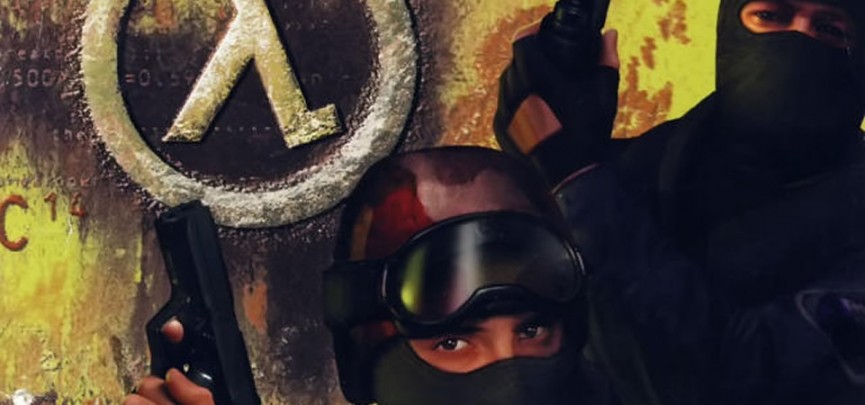
Later, on the 8th of November, Counter-Strike 1.0 was finally released as a full standalone retail game package: “Half-Life: Counter-Strike” (this package included other community Half-Life mods like Absolute Redemption; Wanted; and Firearms). However, it remained downloadable as a free mod for Half-Life – plans for its inclusion in Half-Life had apparently changed since April, although Counter-Strike would also appear in numerous Half-Life anthologies and game bundles released by Valve and Sierra Entertainment (Half-Life’s publisher) during that period.
Counter-Strike was continually updated all throughout its non-beta development period, until it reached what is now considered the sweet spot for Counter-Strike: version 1.6, which was originally released on the 9th of September, 2003. Its release was timed with the first release of Steam itself, and as a result, all future updates for Counter-Strike would be delivered via Steam’s auto-updating framework, with no specific version numbers.
However, these updates rarely included substantial gameplay alterations (with the exception of a series of updates which added Condition Zero content to the game), and to this day, it remains mostly the same. There were loads of other mechanics and elements that Minh “Gooseman” Le would have wanted to add into the game beyond 1.6, but never got the chance to, as people had grown too familiar with 1.6. Many of these elements will re-surface within his upcoming game: Tactical Intervention, a spiritual successor of sorts to Counter-Strike.
That said, 1.6’s server browser has somehow been broken, or perhaps hacked, as it now seems to only feature servers and game sessions from the small Eastern European nation of Romania. What gives, Valve? Things like this should be fixed as fast as humanly possible (particularly when the game in question still manages to hit the top 5 most-played games on Steam).
Right around that time, as 1.6 was dropping, Counter-Strike started to accumulate more and more momentum in competitions, tournaments and leagues. Arguably, Counter-Strike was one of the action games that ushered in the emergence of Western professional first-person shooter competitions in the mid-2000s. To this day, it remains quite popular in the teamplay gaming arena, but since roughly 2008-2009 it’s started to gradually lose Steam.
But what can you expect from a nearly decade-old game? Counter-Strike is aging, to say the least. While it still easily garners 50,000 concurrent players on Steam during peak time, putting it in the top 5 most-played games on all of Steam, you can’t expect a game this old to stay alive for long. Counter-Strike faces a sort of midlife crisis, and it’s a crisis that Valve needs to resolve, if they want to maintain the franchise’s integrity, value and status.
Previous attempts haven’t gone so well. Counter-Strike: Condition Zero passed through the hands of 5 different development studios (Rogue Entertainment; Valve themselves; Gearbox Software; Ritual Entertainment; and respectively, Turtle Rock Studios), before its 2-year overdue release, in March of 2004. While sales were good, overall reception, at the time, was mixed.
The game’s playerbase quickly thinned down not long after launch, as many realized they were playing what amounted to a marginally improved version of 1.6, with two extra single-player modes, and a fairly generous helping of new maps (but not all of them were quite as good as the stock 1.6 maps). Promises had come and gone as entire development studios had departed from the project, presumably at Valve’s request.
Alongside Condition Zero, Valve and Ritual Entertainment also developed an Xbox release of Counter-Strike, which was released in November of 2003. It was entirely based off Ritual’s work on Condition Zero, and it featured Xbox Live functionality for online play, and downloadable game levels. This lesser-known version of Counter-Strike featured content that would never surface in the final version of Condition Zero, released almost half a year later. And believe it or not, this was quite popular in the Xbox community back then!
Still, don’t get me wrong: Condition Zero, as a whole, was quite good, and while it was really not too different from 1.6, it was definitely better in certain respects. But at the time, 1.6 just had too much momentum, and there was no way it would lose any of it to Condition Zero, which simply wasn’t big enough or different enough to make a splash. It’s a shame, because while 1.6’s playerbase still thrives, in a game with a broken server browser; Condition Zero’s small community lives on… with a perfectly working server browser. Oh, if only more people took it seriously!
Besides, the next big Counter-Strike release was right on the doorstep! For Counter-Strike: Source was released mere months later, and it quickly became extremely popular. Bundled with Half-Life 2 (although a beta version had been bundled with Condition Zero, which likely contributed to its sales), it was a much more accessible rendition of the CS formula, and as such it drew the ire of many veteran fans. This led to a massive schism in the Counter-Strike fanbase – one part stuck with 1.6, while the other moved to CS:S. To this day, these two communities remain separated.
However, CS:S has received a huge amount of post-release support over the years, with loads of new maps, features, and a great number of balancing changes – much like HL1 before it, and TF2 after it. In its heyday, CS:S was receiving patches every few days! But one time in October of 2006, in one of the most infamous points in Counter-Strike history, Valve released an experimental Dynamic Weapon Pricing system update for CS:S. It’s one of the most notable and significant changes to the Counter-Strike formula ever attempted by Valve. Fundamentally, it revolved around the concept of establishing a natural, player-governed balance within the in-game weapons economy.
Simply put, weapons purchased very frequently by players across all servers would receive higher prices through this dynamic economy. Meanwhile, lesser bought weapons would become cheaper and cheaper. This would encourage players to try them out, instead of the holy trinity of Counter-Strike weapons: the M4 (and its terrorist counterpart, the AK-47), the AWP sniper rifle, and the Desert Eagle pistol.
But then, even those lesser bought weapons would also gradually grow in price as more players bought them. So in the end, there would be a constant balance across the board, and weapon variety would be much more prevalent on all game servers using the DWP economy. Sounds great on paper, doesn’t it? The idea was clever, but the execution? Well, let’s just say this resulted in the most outrageous and completely ludicrous prices, for commonplace guns and equipment:
- Kevlar and Armor (also known as the Assault Suit) went from $1000 to over $4000. And as we all know, Kevlar and Armor represents a must-purchase in each round of a Counter-Strike match.
- The Desert Eagle, one of, if not the most popular and most widely purchased weapons in the game, went from $650 to over $5000. Early figures from Valve, released publically prior to the launch of the DWP system, estimated that the Desert Eagle would cost over $23,000 in the DWP economy, which would have essentially removed it from the game entirely, since the maximum amount of money a player can carry is $16,000.
- Meanwhile, the Night-Vision Goggles went from $1250 to $1. For the first time in the history of Counter-Strike, people were actually buying NVGs.
- And because the lesser-bought Glock pistols were just as inexpensive, this gave birth to things like this, and this.
And while community servers were completely free to opt out from DWP, Valve eventually realized that it just wasn’t working out – the system was inherently and fundamentally flawed, and it had detrimental effects on gameplay across all servers that used it.
In the end, the Dynamic Weapon Pricing system was only online for little over 1-2 months before it was quietly removed from the game. The only remnant of the DWP updates is the removal of mandatory ammo purchasing, a mechanic which was carried forward into CS: Global Offensive. And this still remains a source of fierce debate among Counter-Strike enthusiasts: to buy ammo, or not to buy ammo?
More recently, CS:S has been receiving content updates from Valve’s newest cohorts: Hidden Path Entertainment, the creators of Defense Grid: The Awakening. Apparently, they’re “right around the corner” from Valve’s offices in Bellevue, and they also helped Valve out with game modelling work on Left 4 Dead 2. In mid-2010, HPE helped Valve out with porting CS:S onto a newer version of Source in order to add Mac support. In the process, they created a significant new content update for CS:S, adding things like TF2’s freezecam, its MVP system, and game achievements.
The update was a bit buggy and unstable, but on the whole, the changes were fairly positive. Besides, most of the new features were optional, and could be disabled from the Advanced Options. We also got some very fancy new effects and particles for the C4 bomb’s explosion to replace the old 2D sprites which had been directly ported over from the original GoldSource games. However, the bold nature of some of the other changes present in the update, particularly the ones applied towards game balancing, made it a bit controversial, and for quite some time, the CS:S community was practically on fire, with cries of CS:S being brought to ruin by that new series of updates.
For instance, one of the most controversial changes was the removal of bunnyhopping, and although it was done through a toggleable server CVar (or “console variable”), all servers had bunnyhopping disabled by default. Now, I realize that the importance and significance of bunnyhopping to the Counter-Strike gameplay formula is something that is entirely debatable. But making these kinds of bold, unparalelled changes through post-release content support is something that developers should stray away from whenever possible. For post-release content support should only serve to add onto a game, rather than detract from it.
This wasn’t the only daring game balance change applied in that series of updates. But it wouldn’t be the last of the updates to be released that summer. And so, with time, all settled down, and Hidden Path managed to address many of the issues and problems that had sprung up. HPE have re-affirmed their commitment to supporting CS:S even after CS:GO is shipped, and let’s hope they keep their word!
And now, here we are. Counter-Strike: Global Offensive is out, after a lengthy closed beta period which began in December of last year. Having been originally announced last August, it is the first new Counter-Strike game since 2004 (unless you count 2008’s CS: Online, which was never even officially released in the West), and Valve’s first FPS release since 2009’s Left 4 Dead 2.
Stay tuned for my extensive review of CS:GO itself, coming very soon! And for more insight into how Counter-Strike, as a whole, has evolved over the years, check out our Evolution of Counter-Strike video series, on YouTube (the fifth part of the series, The Evolution of Office, will be coming to you very soon).
But for a much more in-depth look at how the original game itself changed as time passed, check out Vopo’s Counter-Strike Beta analysis videos.



I am currently doing a research project for C.S and all the information has been rather fun and interesting except i cant find information about the resolution and bits required to play for the first game release: C.S 2000, pls help asap
Awesome article, guys!
Thanks! And your artwork is absolutely amazing, by the way!
A Review of Counter-Strike: Episode One
I love your CS history videos.
Especially those CS beta ones from early 99… aw man those were great times, even tho we had just 56k connection 🙂
We didn’t make those – they were created by a community member.
I’ve got to say, I went in expecting to come out happy and feeling proud of my experiences with Counter-Strike. But the first half of the essay was sort of a broad outline of CS’s pre-Steam days, and the second seemed to focus only the less popular features post-Steam, such as the 5 paragraphs on dynamic pricing.
You were too brief on your discussion about the competitive scene. It was HUGE up until a few years ago; It was, and still is, a bright spot in the games history. Leagues, clans, tournaments, frag movies, hackers – The roots of this stuff are very deep, and it’s one half of why CS is still a very popular game.
The mod scene was big, too, and it’s probably the other half that can be attributed to Counter-Strike’s success. Very few games in the early days were so heavily modified or supported by the community. Server mods, maps, skins, user scripts, etc. Valve didn’t have to create this type of content, but the game was still able to sustain itself for a decade.
I just think the negative stuff shouldn’t have been such a big focus. The game is showing its age, but its history is still very bright and deeply rooted.
Oh well – to each their own!
Thanks for the feedback, but this was not meant to be, nor was it advertised as an in-depth essay on each of the things that made Counter-Strike what it is. It is simply a broad retelling of Counter-Strike’s history – nothing more. Indeed, it was not meant to be negative in any way, shape or form – I like to think the whole thing was nicely neutral.
But your introductory sentence says otherwise. It says you were going to dive deep into CS’s dark history, and you did. There was little coverage of the brighter part of its history, and you focused a lot of efforts on explaining DWP and controversial things like bunnyhops removal, which is not broad. That’s cool if it was your intention, but to my own, I would have liked to have seen more of a balance because the positives are as important as the negatives.
Yeah, just my two cents added to the jar. You’re free to save it or spend it. 🙂
I know perfectly well what my intro says – and right after the bit you quoted, I add that CS’s history isn’t actually so dark… “slightly poorly lit”, as I put it. So there’s no use in taking that into account.
Oh, no – I’d say there was quite a bit of coverage of the brighter part of its history, it just didn’t come off as that pervasive. And frankly, it didn’t need to be that pervasive (otherwise, it’d have treaded on the territory of bias). Give it a few more reads and you’ll start to see how it all fits in a lot better.
Those older moments in the community all carry different sorts of historical, and perhaps, emotional baggage. Understand that anyone who remembers them won’t need to be reminded how great they were; and similarly, understand that it is fundamentally pointless to try to explain how great those days were to anyone who wasn’t around back then.
Explaining DWP did not carry any negative connotations at all; didn’t you notice how I explicitly explained why I considered it a great idea on Valve’s part? Of course, I couldn’t explain that without explaining how the system actually worked. So, credit where credit is due; and criticism where criticism is due.
As for the removal of bunnyhopping… well, now, you can’t talk about CS:S without talking about the events of June 2010, and even so, I do believe I did a solid job of discussing it fairly, objectively and neutrally. There was much more I could have said, but this was not an opinion piece, so I added only that which was strictly necessary.
It seems the problem here is that you might have gone in expecting some sort of nostalgic piece which would have helped you reminisce on the “good old times”. With those expectations in mind, you might have seen the content here in a different light. Again, I did not advertise it as such, nor did I intend to be anything like that. It is simply a largely neutral, broad retelling of the history of this noble franchise.
But I do thank you for your two cents, nonetheless – although the exchange rates can be rather tough, so to speak. 🙂
l4d3(hl3)
they just fixed the HL1 based server browser a week or two ago, removing the fake and cracked servers, which move essentially murdered the half-life deathmatch scene, as they were mostly active on cracked servers because that was the only source of new players to play with for years now.
I was going to say…
I haven’t heard or read about this problem anywhere and it seemed to be local to just Vic (maybe I wasn’t looking hard enough). I checked on forums and saw no mention of only Romanian severs.
Then I’m afraid you might not have looked too much at the forums at all – there’s actually a thread about this issue, right on the front page. Then there’s a few more on page 2, and a couple more on page 3, and so on. You can keep going, and at one point it will become apparent that this is an extremely widespread phenomenon, and I assure you that it is not local to my machine (several of my friends have also experienced it).
In addition, I’ve seen or heard nothing about any possible official fix, directly from Valve. There is a workaround that involves messing with the “config.cfg” file, but as far as I know, this issue remains present in 1.6 to this day.
Great read Vic, just learned stuff about CS I never even knew about.
If you were my history teacher and taught me stuff like this every day, I’d actually pay attention in school haha.
Can’t wait for the review!
Very well written, thanks.
Do l4d story next afer cs:go and i’ll be here forever.
^That
When L4D3 comes out? Absolutely!